
Documentation

Connect Pace to Zoom

Connect Zoom to sync your cloud recordings and transcripts, so every customer call is summarized and attached to the right deal automatically. Setup takes about a minute, and the connection is read-only.

Zoom Pace for Zoom
Call recording · Transcripts · Deal activity

Your Zoom calls, on the deals they belong to.

The Pace integration reads your Zoom cloud recordings and their transcripts, works out which account each call belongs to from who was on it, and attaches it to that account's deals. From there Pace summarizes the call and folds what was said into deal risk and forecast signals. The connection is read-only: Pace never starts, stops, deletes, or alters anything in Zoom.

App Pace for Zoom
Auth OAuth 2.0 (Zoom-hosted consent)
Syncs Cloud recordings · Transcripts · Meeting participants
Direction Zoom → Pace (read only)
Pace never writes to Zoom
History Last 90 days backfilled on connect
Setup time ~1 minute · one Zoom admin

The data Pace reads from Zoom.

Pace reads cloud recordings and the metadata around them. Nothing else in your Zoom account is touched — no chats, no webinars, no user settings, no meeting configuration.

Cloud recordings
Each recorded meeting's title, start time, duration, and a link back to the recording in Zoom. These become calls in Pace, listed on the account and deal timeline.
  • Only cloud recordings. Recordings saved to a local machine never reach Zoom's API, so Pace can't see them.
Transcripts
Zoom's audio transcript for each recording, fetched and cached by Pace so it stays readable in-app behind See full transcript — and so the AI can quote and reason over what was actually said.
  • A recording with no transcript still syncs; it just won't have a summary.
Meeting participants
Who attended each past meeting — their email addresses, and phone numbers for dial-in attendees. This is the signal that attaches a call to an account: Pace matches participants against your CRM contacts, falling back to phone numbers when there's no email.
Cloud recording has to be on. Pace syncs what Zoom's cloud-recording API exposes, which means the meeting must have been recorded to the cloud — a paid Zoom feature. If your team records locally, or doesn't record at all, there's nothing for Pace to read.

Connect your Zoom account.

You can connect Zoom from within your Pace workspace, or from the Zoom App Marketplace. Both paths use Zoom's own consent screen — you approve the connection inside Zoom and land back in Pace, connected. You'll need to be able to authorize apps for your Zoom account, since the permissions Pace requests are account-level.

Connect from Pace

Recommended · app.pacehq.ai

Recommended
  1. Sign in to Pace at app.pacehq.ai as an organization admin.
  2. Open Settings from the left sidebar, then select the Integrations tab.
  3. Choose the Call recording category, find Zoom in the list, and click Connect.
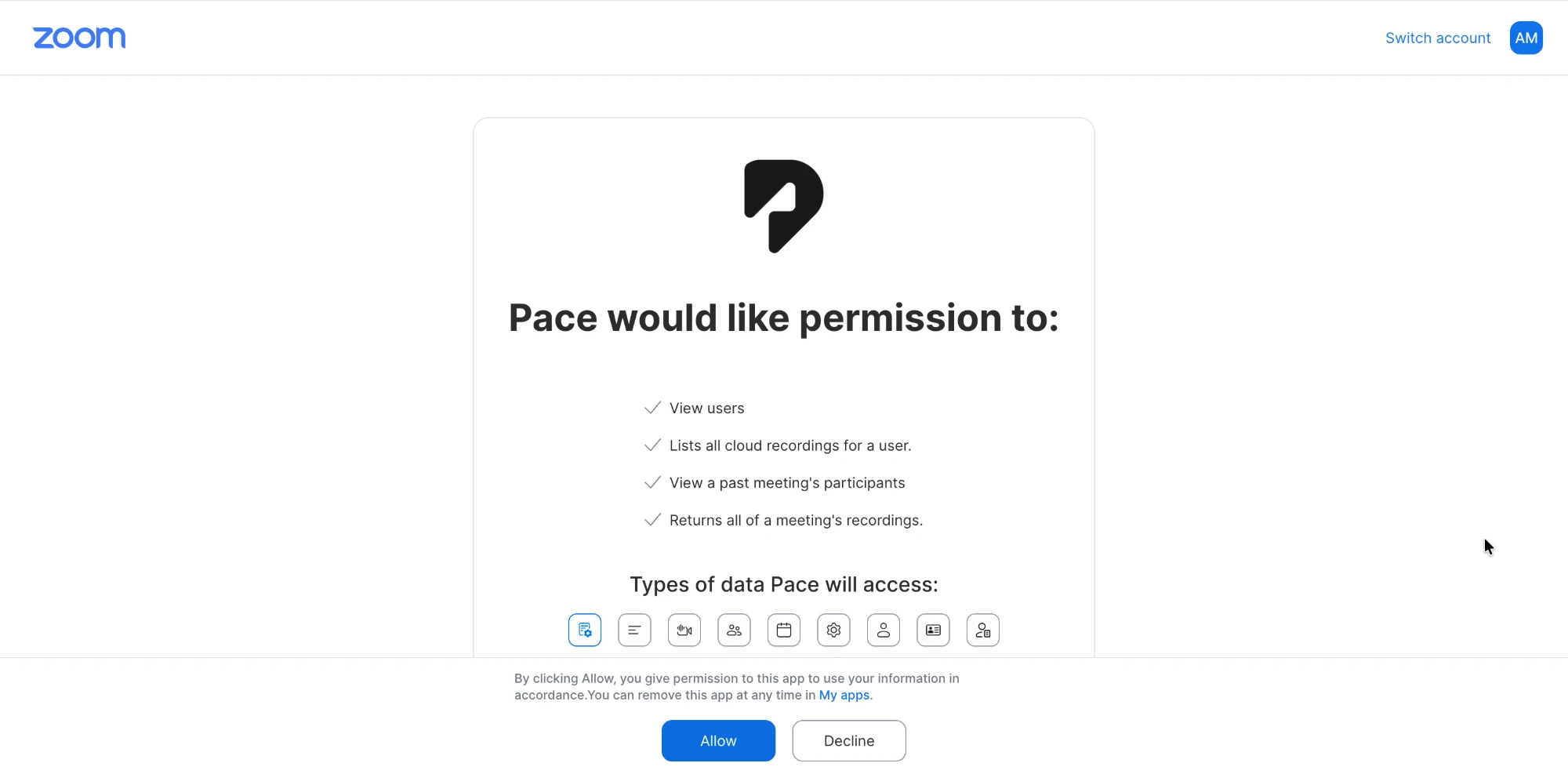
  4. You're redirected to Zoom's consent screen, headed "Pace would like permission to:". Review the four read permissions and click Allow.
  5. Zoom sends you back to Pace. The Zoom row now shows Connected with its connected and last-sync timestamps, and the first sync begins automatically.
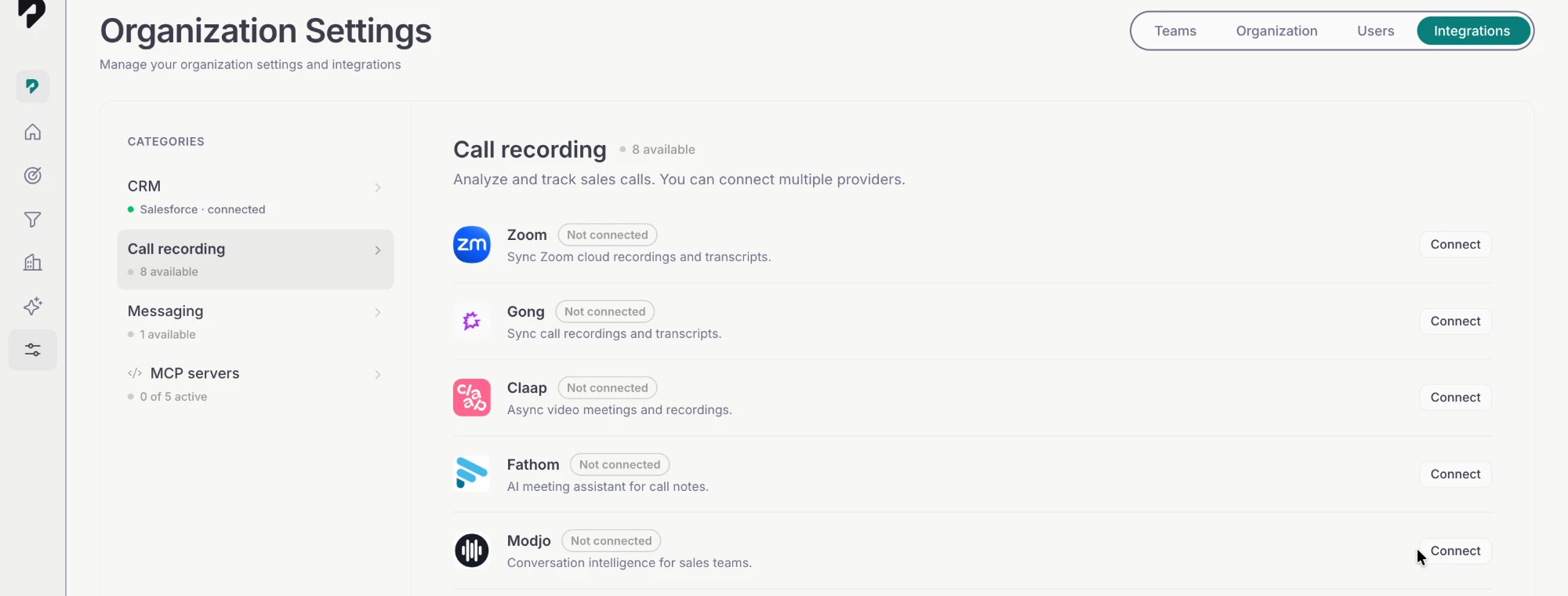
Pace Organization Settings, Integrations tab: the Call recording category, headed 8 available, lists the call-recording providers — Zoom at the top, then Gong, Claap, Fathom and Modjo — each marked Not connected with a Connect button
Settings → Integrations → Call recording. Click Connect on the Zoom row to start the OAuth flow. Unlike your CRM, call recording isn't one-at-a-time — you can connect Zoom alongside any other provider listed here.

After connecting: Pace backfills the last 90 days of cloud recordings, then classifies and summarizes each one. Larger accounts take a while to work through — calls appear on deals as they're processed rather than all at once.
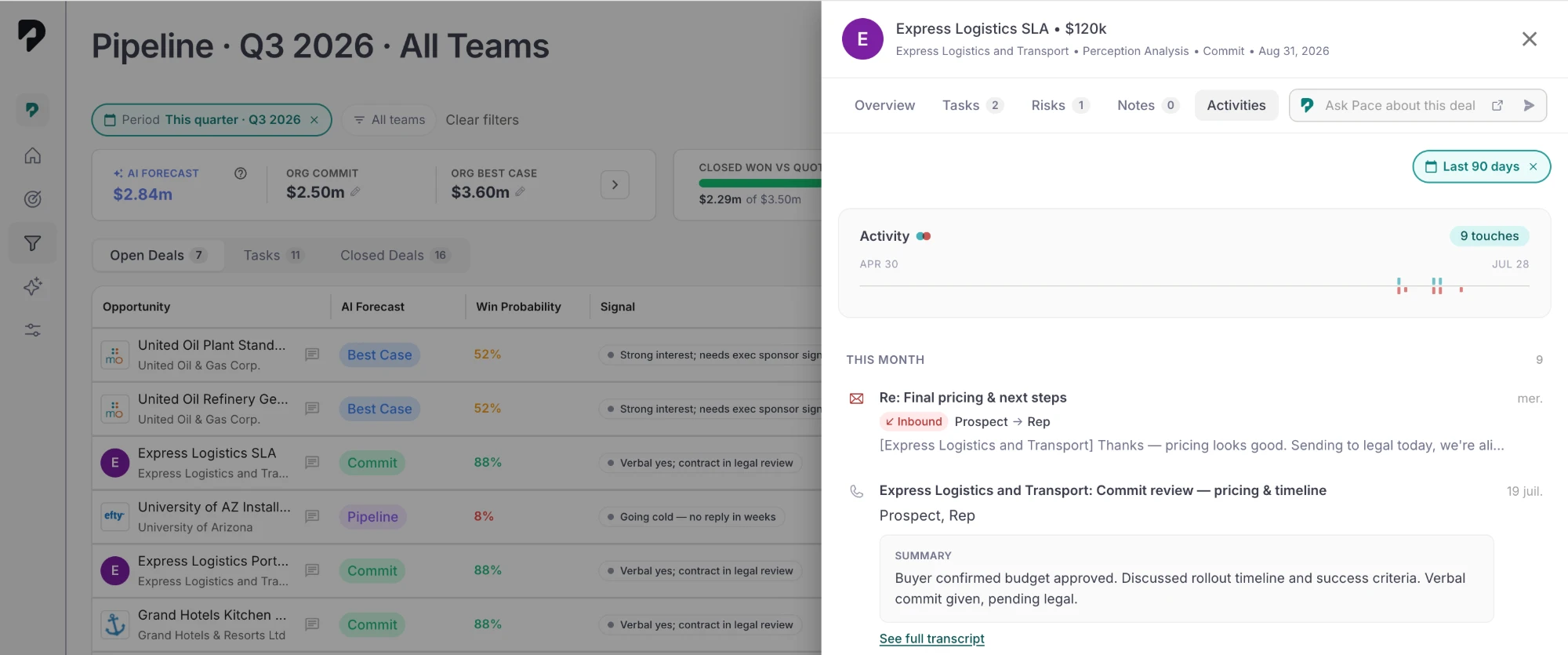
A Pace deal drawer open on the Activities tab for the Express Logistics SLA opportunity, showing an inbound email and a synced Zoom call with a generated SUMMARY block and a See full transcript link
Your Zoom calls on the deal. Synced calls land in the deal's Activities tab alongside emails, each with its generated summary and a link through to the full transcript.

Read only, end to end.

Every permission Pace requests from Zoom is a read permission. There is no write path at all — not to recordings, not to meetings, not to users or settings. Pace consumes your recordings; it never manages them.

What Pace reads
Cloud recording metadata and files, the transcript for each recording, the participant list for past meetings, and your Zoom user list so each call is attributed to the right rep.
  • Access is scoped to the single Zoom account you authorize.
  • Transcripts are cached in Pace so they stay readable in-app and available to the AI.
What Pace writes
Nothing. All four granted permissions are read scopes, so there is no write Pace could perform even in principle.
  • Never starts, stops, or schedules a meeting.
  • Never deletes, moves, or edits a recording or its transcript.
  • Never changes users, settings, or account configuration.
  • Summaries, classifications, and call notes generated by Pace stay in Pace.

What Pace asks for, and why.

Zoom shows you exactly what Pace is requesting on its consent screen. Four scopes, all read-only. Each one maps to a specific line on that screen — the table below is the technical name, the screen shows Zoom's own wording.

Requested scopes — read only
user:read:list_users:admin Read the Zoom account's user list, so each recording is attributed to the rep who ran the call. Shown as "View users".
cloud_recording:read:list_user_recordings:admin List the cloud recordings belonging to the account's users — the set of calls Pace syncs. Shown as "Lists all cloud recordings for a user."
cloud_recording:read:list_recording_files:admin Read the files attached to a recording, including the audio transcript. Shown as "Returns all of a meeting's recordings."
meeting:read:list_past_participants:admin Read who attended a past meeting. These are the addresses Pace matches to accounts and contacts. Shown as "View a past meeting's participants".
Zoom's consent screen headed "Pace would like permission to:" listing four checked permissions — View users; Lists all cloud recordings for a user; View a past meeting's participants; Returns all of a meeting's recordings — above an Allow and a Decline button
Zoom's consent screen. The same four permissions as the table above, in Zoom's own words. Approve with Allow. Every line is a view or list permission — there is nothing here that lets Pace change your Zoom data.
Account-level, and revocable. These scopes are granted at the account level, so once an admin approves, Pace can sync cloud recordings across the Zoom account — not only the recordings of the person who connected it. Access is limited to the one account you authorize, is read-only, and can be revoked at any time from Zoom's Installed Apps settings. See the Security Policy and Privacy Policy for how call data and transcripts are stored and handled.

Common questions.

How do I disconnect Zoom?

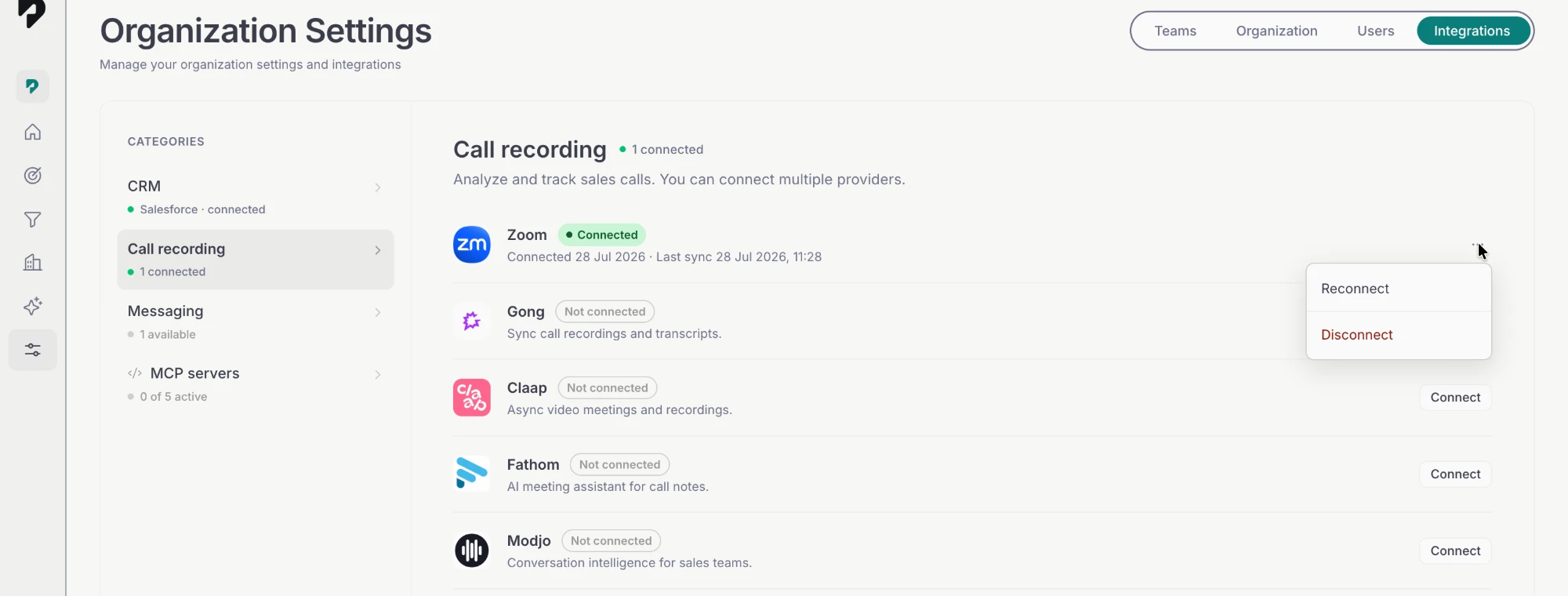
In Pace, open the ··· menu on the Zoom row under Settings → Integrations → Call recording and choose Disconnect. The definitive way is to remove the app in Zoom, under Manage → Installed Apps — that invalidates Pace's access immediately.

What is Reconnect for?

Zoom's refresh tokens rotate on every use and expire after 90 days, so a connection that sits idle long enough will eventually go stale and stop syncing. Reconnect re-runs the consent flow and resumes syncing from where it left off — you won't lose already-synced calls.

The Zoom row in Pace showing a green Connected badge with its connected and last sync dates, and the ⋯ menu open on two items, Reconnect and Disconnect
The menu on a connected Zoom row. The row also shows when the connection was made and when it last synced.

How far back does it sync?

The first sync backfills the last 90 days of cloud recordings. It works through that range oldest-first in weekly windows, saving its progress after each one, so a sync that's interrupted picks up where it stopped instead of starting over.

A call I just finished isn't in Pace yet.

Zoom needs time to finish processing a recording and generate its transcript before either is available over the API, so Pace deliberately holds back on the most recent few hours rather than syncing a half-ready recording. Very recent calls appear on a later sync.

A call synced but didn't attach to a deal.

Calls are matched to accounts by who was on them — participant email addresses first, phone numbers as a fallback for dial-in attendees. A call can fail to match if the customer joined from a personal address that isn't on any CRM contact, or dialled in from an unknown number. Adding that address or number to the contact in your CRM lets a later sync attach the call.

Can I connect more than one call-recording provider at the same time?

Yes. Call recording isn't one-provider-at-a-time the way your CRM is — connect as many of the eight supported providers as you use, and Pace pulls calls from all of them.

Who can connect it?

In Pace, a user with the manage connections permission — without it, the Connect and ··· menu actions are unavailable. In Zoom, someone able to authorize an app for the whole account, since the requested scopes are account-level.

Need a hand? Email support@pacehq.ai and our team will help you get connected.